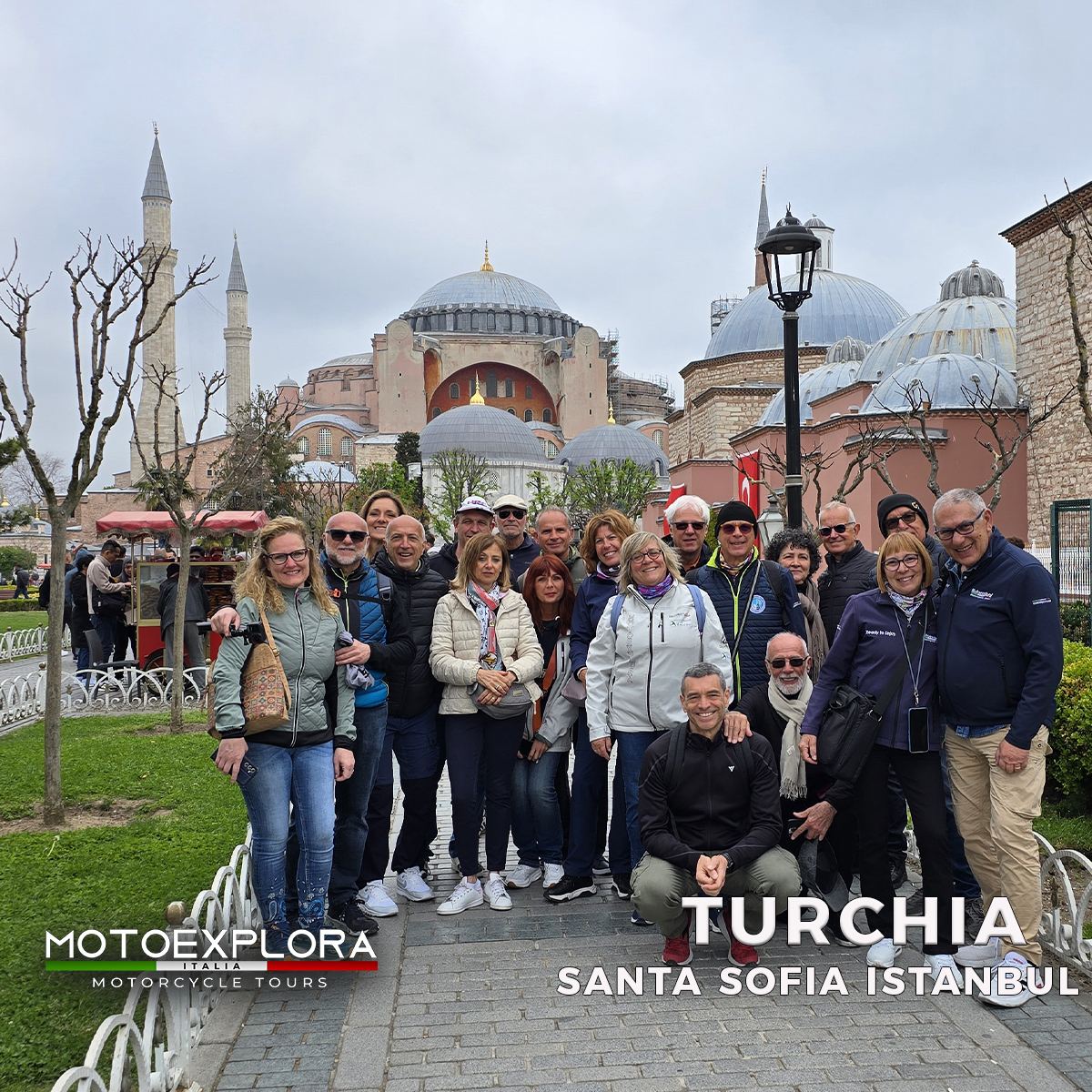
When you arrive in Istanbul by motorcycle, after crossing bridges suspended between Europe and Asia, you understand straight away that this is no ordinary city. It is a crossroads of cultures, scents, sounds and eras living together in the same breath. And in the beating heart of this metropolis, between the waters of the Bosphorus and the echo of the call to prayer, stands one of the most extraordinary monuments in the world: Hagia Sophia, or as the Turks call it, Ayasofya.
For us at Motoexplora, Hagia Sophia is not just a cultural stop: it is one of those experiences that stay inside you, like a perfect bend taken at just the right speed. It is the symbol of a journey through time, a place where East and West have been shaking hands for more than fifteen hundred years.
A history that spans empires
Hagia Sophia was built in 537 AD, under the Byzantine emperor Justinian I, with the aim of creating the largest and most majestic church in the world. And so it was. When its doors opened for the first time, no other religious building could compete with its grandeur. The dome, over 55 metres high and 31 wide, seemed suspended in the sky, so much so that Justinian himself, admiring it, exclaimed: “Solomon, I have surpassed you!”
For almost a thousand years, Ayasofya was the main cathedral of Eastern Christianity, until 1453, when Mehmed the Conqueror entered Constantinople and turned it into a mosque. Minarets, a mihrab and a minbar were added, but the Byzantine mosaics – although covered – lived on under the layers of plaster, silent witnesses of a past that never dies.
In 1935, Mustafa Kemal Atatürk, father of modern Turkey, decided to turn it into a museum, a symbol of a secular and open country. Then, in 2020, Hagia Sophia became a mosque again, but it still welcomes visitors of every faith and background, keeping its aura of universal sacredness intact.
The experience of going inside: between light and silence
Entering Hagia Sophia is like stepping through a portal in time. As soon as you cross the threshold, you are wrapped in an atmosphere that is hard to describe in words. The light filters through the high windows, golden and soft, lighting up the tiles of the mosaics depicting Christ, the Virgin Mary and the Byzantine emperors. You walk on floors polished by millions of steps, feeling the weight of history under the soles of your boots.
Every column, every arch, every stone tells a different era. And as your gaze gets lost in the majestic central dome, you realise that Hagia Sophia is not just a building: it is a dialogue between worlds, between the human and the divine, between past and present.
Arriving by motorcycle: the emotion of the journey
For those who travel with us at Motoexplora, arriving in Istanbul is a stop worth the whole trip. After crossing Thrace, with its roads snaking between villages and plains, you glimpse the outline of the city in the distance, the minarets standing out against the sky and the chaotic traffic welcoming you with all its energy.
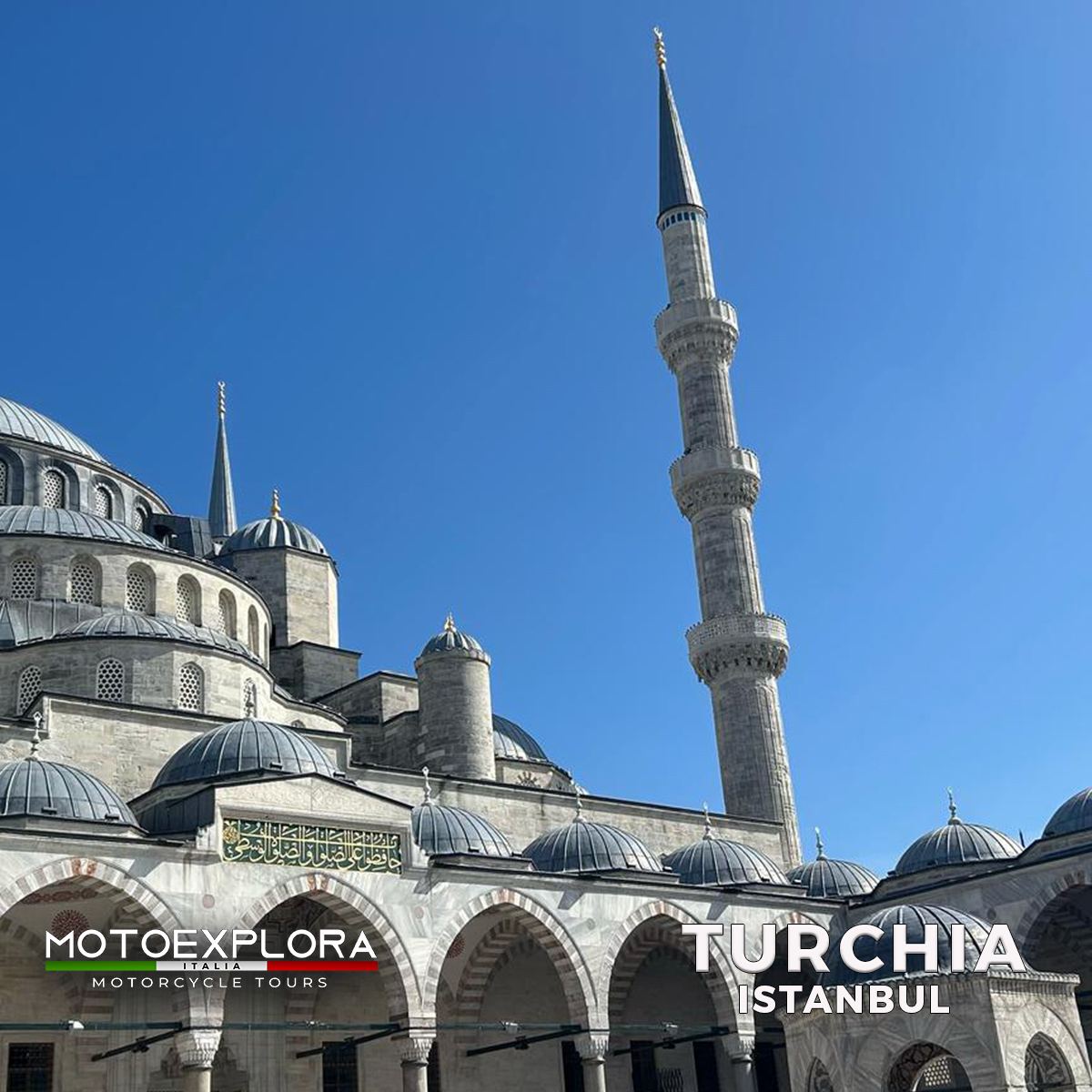
Parking the bike near the Sultanahmet district, switching off the engine and hearing only the hum of the city is a magical moment. Hagia Sophia is right there, next to the Blue Mosque and the ancient Roman Hippodrome. A few steps are enough to plunge into the heart of history.
What not to miss nearby
After the visit, we suggest sitting in one of the cafés with a view of the dome, sipping a strong, aromatic Turkish tea. Or crossing the park to the Blue Mosque, a masterpiece of Islamic art. From there, a few minutes’ walk takes you to Topkapı Palace and the Grand Bazaar, a maze of colours and scents that tell of the city’s merchant soul.
Why Hagia Sophia is a symbol of travel
For us, travelling means discovering, respecting and understanding. Hagia Sophia perfectly embodies this spirit: it is the fruit of different civilisations, united in a single masterpiece. It is proof that beauty is born from encounter, not from division. And every time we visit it, it reminds us why we love travelling on two wheels: because the road, just like Hagia Sophia, is a bridge between cultures and people.
In the saddle towards new destinations
Leaving Istanbul, with the dome of Hagia Sophia reflected in your mirrors, you take with you something more than a simple image: you take an emotion, a piece of history, and the awareness of having touched one of the most significant places in the world.
Hagia Sophia is not just a destination. It is an encounter, a story, a symbol.
And like every Motoexplora trip, it is an experience that stays in your heart.