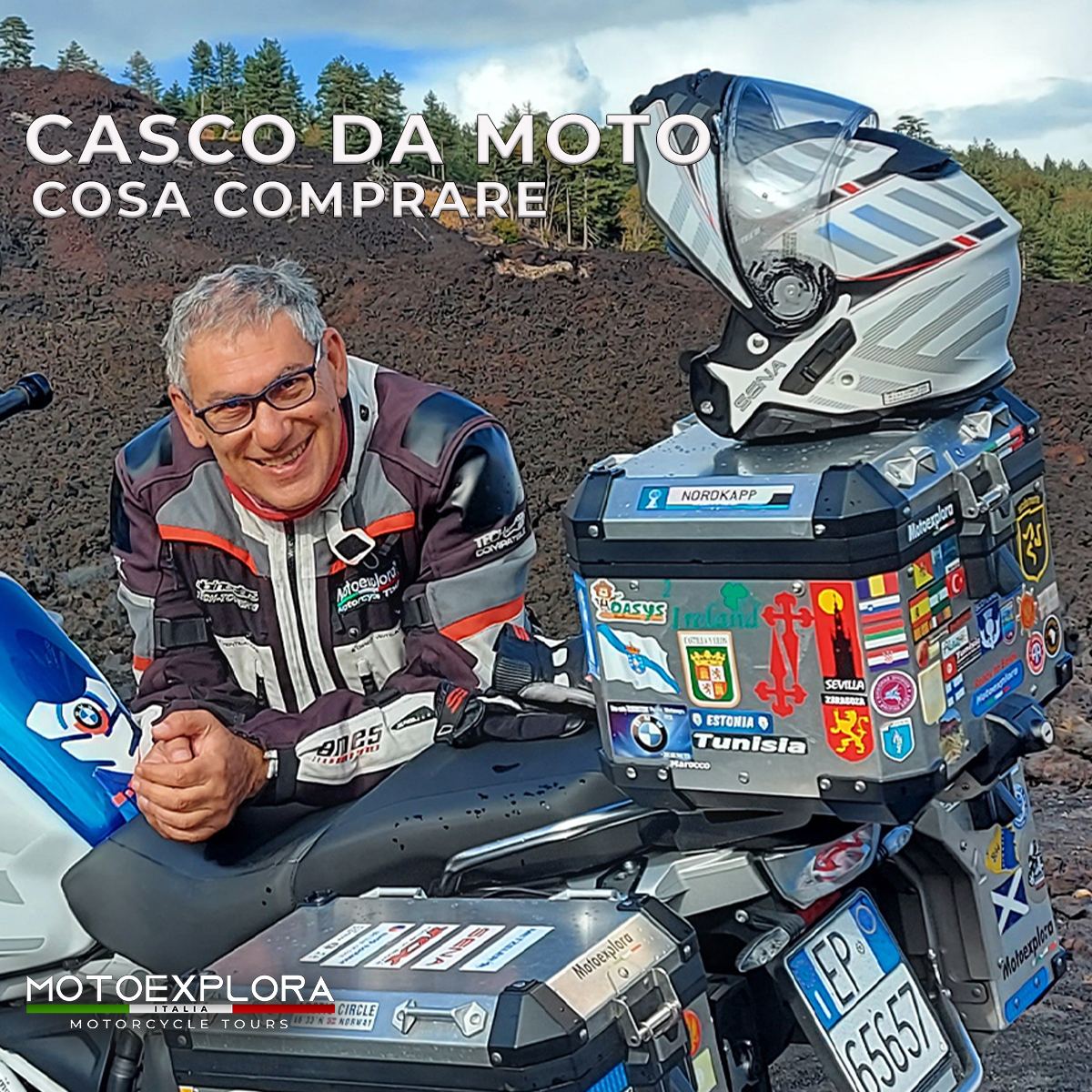
by Peppe Pagano
If there is one question I am asked often, especially before a long trip, it is always the same:
what is the best helmet for motorcycle travel?
The short answer is simple:
there is no such thing as the perfect helmet.
But there is the right helmet for the way you travel.
And that is something I only learned after many kilometres, many helmets and a few too many mistakes.
On a trip the helmet is not a detail
When you travel by motorcycle, the helmet becomes part of you.
You wear it for hours, in the sun, in the wind, in the rain, on motorways and on back roads.
If the helmet is wrong:
- it tires you out
- it makes you arrive irritable
- it ruins your day
And it does not matter how beautiful the road is if after 300 km your neck hurts or the noise gets into your head.
I learned that comfort comes first
At first I looked for the “best-looking” helmet, then the lightest, then the most technical.
Over time I understood something very simple: on a trip, comfort is everything.
A good touring helmet must:
- not make itself felt after hours
- be quiet
- have good ventilation
- let you stop without taking it off every time
If you forget you are wearing it, you have made the right choice.
Full-face: safety and silence
I have travelled a lot with a full-face helmet, especially on the road.
If the trip is long and fast, with a lot of motorway or mountain passes, the full-face remains a sure bet.
It is more:
- quiet
- stable
- protective
Especially when you are eating up the kilometres, silence becomes a real luxury.
Modular: the ideal travel companion
In recent years, though, I have often used a modular helmet.
And it is no coincidence.
On a trip you make lots of stops: fuel, photos, coffee, checks.
Lifting the chin bar without taking off the helmet changes the experience completely.
For me today the modular is:
- practical
- comfortable
- perfect for touring
With modern modular helmets you no longer make big compromises on either safety or comfort.
Adventure helmet: when the road ends
When the trip becomes mixed, when dirt roads come into the route, then the adventure helmet makes sense.
A wide visor, air, the option of wearing goggles.
It is a “freer” helmet, less protective on tarmac, but perfect when you are exploring.
Here we need to be honest:
on the road it is noisier, but on certain trips it is the right choice.
Weight matters more than you think
One thing many people underestimate is weight.
Not so much the number on the scales, but how it is distributed.
A badly balanced helmet will wreck your neck.
After 6–7 hours you certainly notice it.
Better a slightly heavier but well-balanced helmet than a light and unstable one.
Noise is the real enemy
If there is one thing I have learned travelling, it is that noise tires you more than kilometres.
A quiet helmet:
- lets you arrive clear-headed
- lets you enjoy the trip
- makes the intercom usable
On a trip I always prefer a helmet that is a little warmer but quiet, rather than one that is super-ventilated and noisy.
The best helmet? The one that lets you travel with peace of mind
In the end, after many kilometres, I understood that the best helmet for motorcycle travel is the one that:
- does not make you think about it
- does not bother you
- does not tire you
Whether it is full-face, modular or adventure matters less than how you use it and where you go.
When you turn the key and set off, the helmet should disappear.
If you can feel it, something is wrong.
Because motorcycle travel is made of road, wind and horizons.
And the right helmet is the one that lets you live them without distractions.
Peppe Pagano